
The arrival of the Normans in 12th-century Ireland brought more than just knights and ambition—it reshaped the Irish landscape with motte and bailey castles, the earliest symbols of their military and administrative dominance.
What Is a Motte and Bailey Castle?
These castles had two key parts:
- A motte – a large earthwork mound, usually topped with a timber tower or later a stone keep.
- A bailey – an enclosed courtyard next to the motte, often surrounded by a wooden palisade and a deep fosse (ditch).
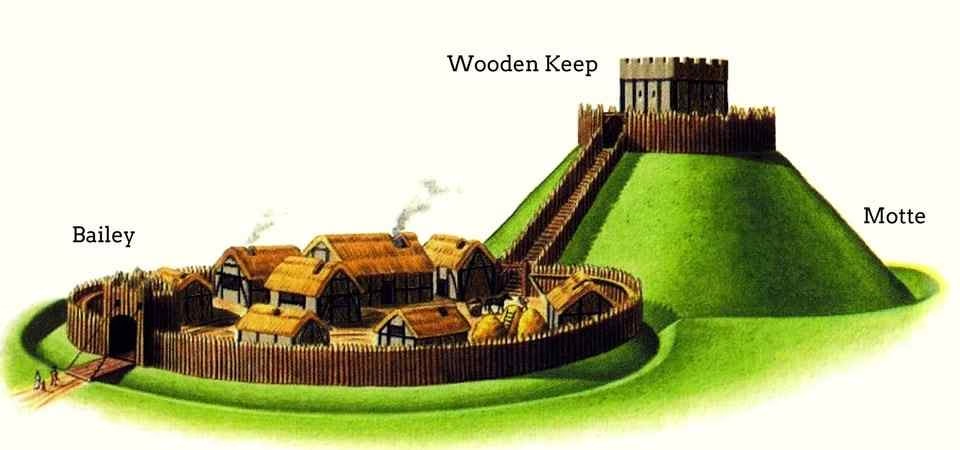
The term “motte and bailey” is a relatively modern construct, not originating in the medieval period. The word “motte” is derived from the French adaptation of the Latin mota, originally meaning a piece of turf. In France, motte came to describe a turf bank, and by the 12th century, it was used to refer to the castle design itself. The term “bailey” comes from the Norman-French baille or basse-cour, which referred to a low courtyard. In medieval texts, the Latin term castellum was often used to describe the bailey area of these castles.
They were quick to build, cheap to construct with local materials, and intimidating to look at—making them ideal for a fast-moving military campaign like the Norman conquest of Ireland.
When and Why They Came to Ireland
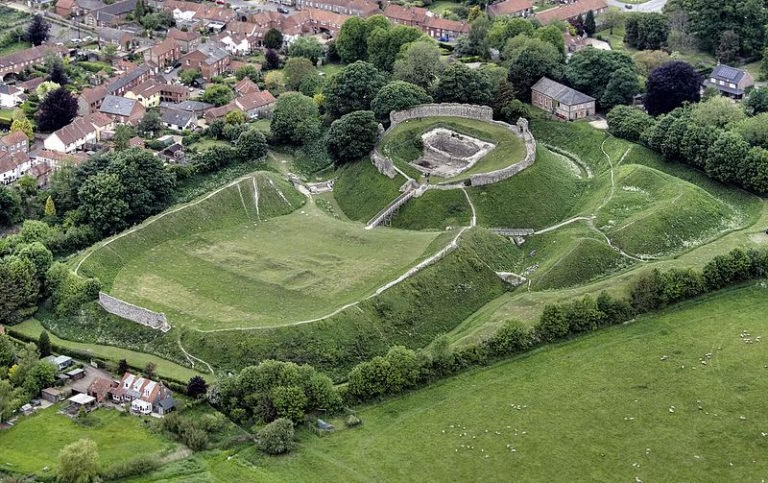
The Normans first landed in 1169 at the invitation of Diarmait Mac Murchada, the deposed King of Leinster. With them came their unique approach to fortification. By 1171, the landscape of eastern Ireland was dotted with these wooden castles.
These were not just forts—they were also centres of local government, law enforcement, and tax collection (the Norman “manor” or area of land with fixed boundaries, ruled over by a lord). And, crucially, they announced: “This land is now under new management.”
Often a parish church was provided for the inhabitants.In County Meath alone, there may have been as many as 98 manorial villages, each typically featuring a church, and often a castle and mill.
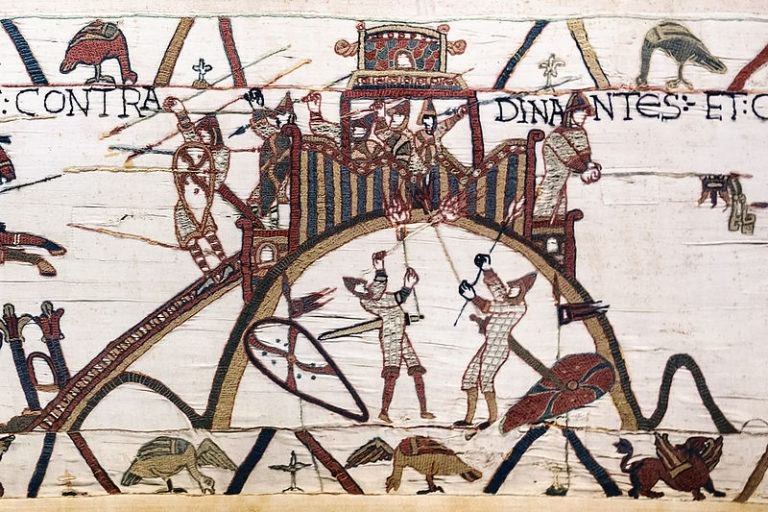
While not universally the case, the motte was often replaced with a stone castle as the Normans became more firmly established in a given area, as the wooden structures were easy to attack with fire.
The old village of Moynalty, for example, sprang up close to the castle at Crochawella, however the motte on the opposite side of the river would have been where the Normans originally set up.
Kilbeg Motte, County Meath
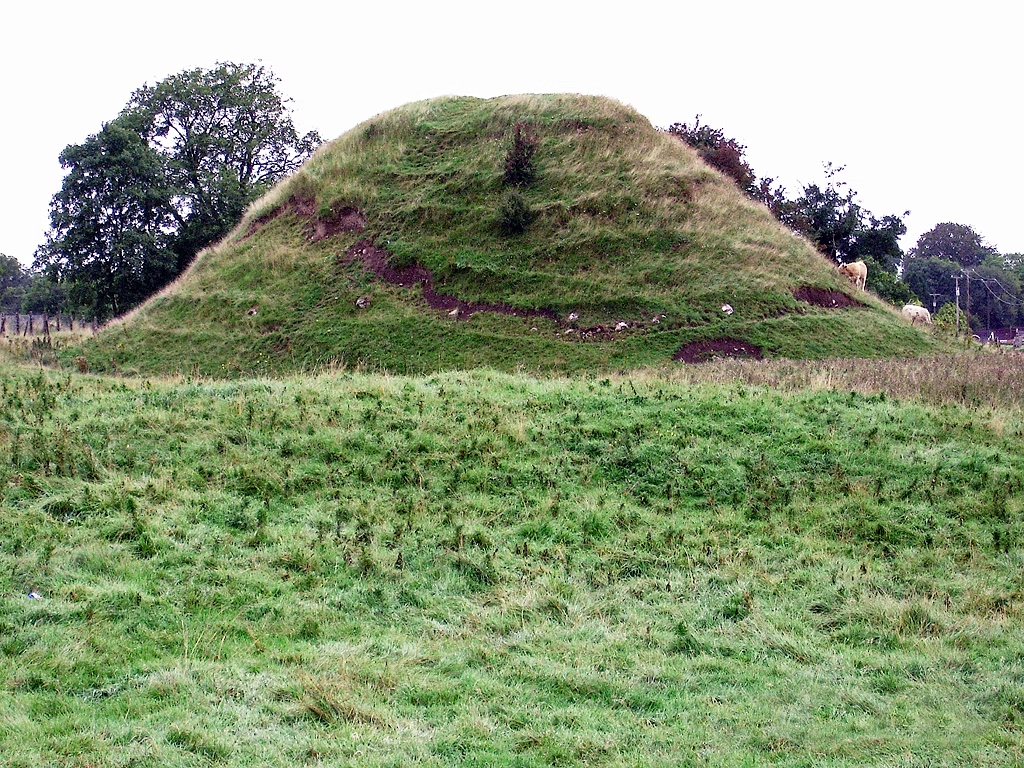
Nestled quietly in the countryside near Kells, the Kilbeg Motte is a classic example of Norman strategy in action. It overlooks fertile lands and sits near historic Gaelic strongholds. Though it appears today as a grassy mound, it was once a power centre—a caput, or administrative hub—for a Norman lord.
Local tradition holds that the motte at Kilbeg contains an underground passage stretching some 20 perches in length, running from Kilbeg Bridge to the base of the mound.
Its inclusion in the Record of Monuments and Places (RMP ME017-016) confirms its national significance.
The mottes around Kells were likely constructed under Hugh de Lacy, the first Norman Lord of Meath, or possibly by Gilbert FitzThomas, one of his knights who received the lands around Kenlis (modern-day Kells).
Other Notable Irish Mottes
Ireland has over 250 motte sites still visible. Some of the best-known include:
- Granard Motte, Co. Longford – the largest in Ireland.
- Trim Castle, Co. Meath – eventually rebuilt in stone, but likely began as a motte.
- Ardnurcher, Co. Westmeath – another frontier stronghold.
Many were built near important monastic or tribal centres—often quite deliberately.
Terms to Know: Fosse and Caput
- Fosse: This is the ditch or moat that often surrounds the motte and bailey. It added an extra layer of defence and helped define the site’s boundaries.
- Caput: A Latin term meaning “head,” used to describe the main castle or seat of power within a Norman lord’s territory. The caput was often the motte-and-bailey site from which landholdings were administered.
A Lasting Legacy
Though the timber structures have long since disappeared, the earthworks remain—often mistaken for ringforts or fairy forts. But look closely, and you’ll see they mark a dramatic shift in Irish history: a new class of rulers, a new way of organising land, and the beginning of centuries of change.
📚
References
Barry, T. (1987). The Archaeology of Medieval Ireland. London: Routledge.
Callery, B., & Callery, J. (2000). Beyond the Borora: Kilbeg, Tierworker and Moynalty in History and Folklore. Moynalty: Private publication.
Duffy, S. (Ed.). (1997). Medieval Ireland: An Encyclopedia. London: Routledge.
French, N. (2011). Tracing the Normans in County Meath. Meath Archaeological and Historical Society.
McNeill, T. E. (1997). Castles in Ireland: Feudal Power in a Gaelic World. London: Routledge.
National Monuments Service. (n.d.). Historic Environment Viewer & Record of Monuments and Places (RMP). Retrieved from www.archaeology.ie
O’Byrne, E. (1995). “The Kingdom of Meath in the Twelfth Century.” In D. Ó Cróinín (Ed.), Seanchas: Studies in Early and Medieval Irish Archaeology, History and Literature in Honour of Francis J. Byrne (pp. 166–181). Dublin: Four Courts Press.
O’Keeffe, T. (2000). Medieval Ireland: An Archaeology. Stroud: Tempus.
Comments