
Where Was the Book of Kells Written?


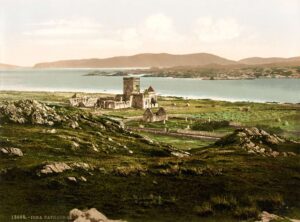
The Book of Kells is a masterpiece so magnificent that Ireland, Scotland, and England are all vying for bragging rights over its creation. Where was the Book of Kells written? It’s like the literary equivalent of a family heirloom that everyone claims to have inherited.
Let’s set the scene: the 6th-century Irish monk, Colmcille (or Columba, depending on which side of the Irish Sea you’re on), establishes a monastery on the Scottish island of Iona.
Fast forward to around 800 AD, and the Book of Kells is believed to have been created in a Columban monastery, either in Ireland or Scotland. This has led to a friendly tug-of-war over its origins. England, not wanting to be left out, occasionally throws its hat into the ring, perhaps hoping that some of the book’s brilliance will rub off by association.
But let’s not forget: those monks who journeyed to Iona were Irish, bringing their homeland’s flair to the manuscript. The Book of Kells shares similarities with the Book of Durrow, an illuminated manuscript nearly a century older, likely crafted in or near Durrow Abbey, County Offaly—another of Colmcille’s foundations. Clearly, the Irish influence is as bold as the intricate designs adorning these pages.
The Temptation of Christ (Book of Kells)
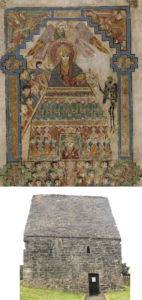
Now, about that intriguing illustration in the Book of Kells known as “The Temptation of Christ.” Some scholars suggest that the structure depicted resembles Colmcille’s House in Kells, an oratory or scriptorium. It’s as if the artist decided to include a little “home sweet home” touch amidst the holy narrative.
The Book of Kells found sanctuary in Kells for nearly 800 years before being entrusted to Henry Jones, the Bishop of Meath, who then handed it over to Trinity College Dublin for safekeeping. It’s been there ever since, dazzling visitors and scholars alike.
In the end, the Book of Kells serves as a beautiful testament to the intertwined histories of Ireland and Scotland under the banner of Colmcille. It’s a shared heritage that transcends borders—though, let’s be honest, the Irish might have a slightly stronger claim. But who’s keeping score?