
Of Dick Farrelly, The Quiet Man and The Isle of Innisfree: A Musical Legacy
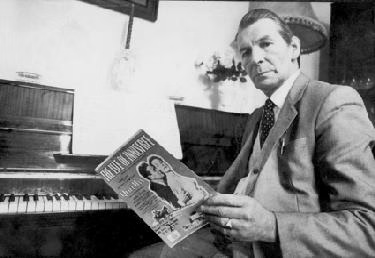
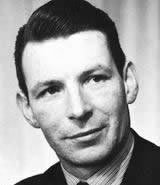

The Isle of Innisfree is a song composed by Richard “Dick” Farrelly, an Irish songwriter, policeman, and poet from Church Street, Kells, County Meath.
Inspired during a bus journey from his native Kells to Dublin, Farrelly got the inspiration for his now timeless composition. By the time he reached Dublin, he had written both the words and the music, capturing the deep longing of an Irish emigrant for home.
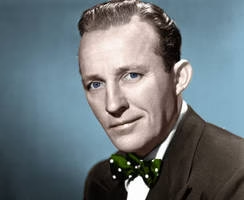
Published in 1950 by The Peter Maurice Music Publishing Co., the song became a worldwide hit when Bing Crosby recorded it in 1952.

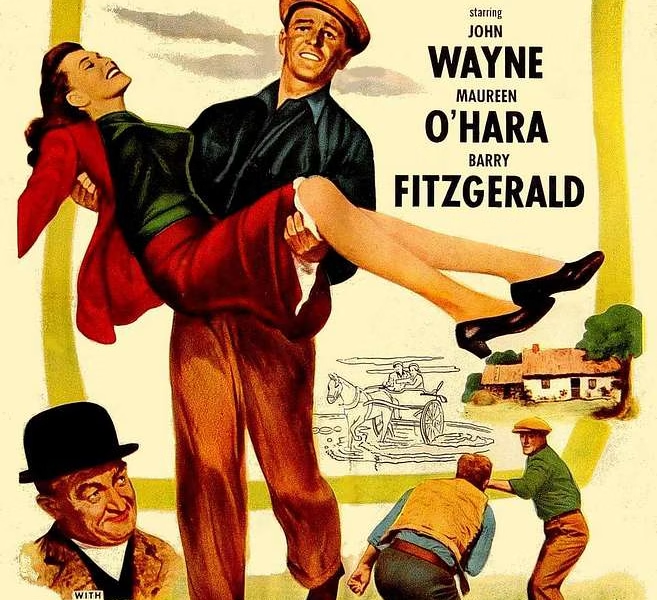
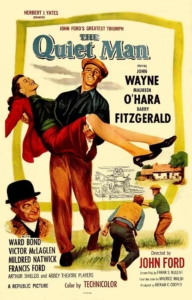
When film director John Ford heard The Isle of Innisfree, he was so moved that he chose it as the principal theme for the film The Quiet Man (1952). Its haunting melody became the love theme for Sean Thornton (John Wayne) and Mary Kate (Maureen O’Hara), beautifully orchestrated by Victor Young.
The melody appears in the opening sequence and is played a further ten times throughout the film. Despite its pivotal role, Farrelly received no screen credit, as the full musical score was attributed to Young. Nonetheless, The Isle of Innisfree remains an enduring Irish classic, recorded by countless artists worldwide and featured in films such as E.T. the Extra-Terrestrial (1982) and Distant Voices, Still Lives (1988).
Shortly after Farrelly composed the song, he gave the original manuscript to Vera Cummiskey so that her brother, Detective Garda Joseph Cummiskey from Kells, Co. Meath, could perform it in public for the very first time. He sang it on 17th March 1953 in the Vincent de Paul Hall in Kells.
A mix-up exists that both the song and the famous poem of W. B. Yeats, “Lake Isle of Innisfree“, refer to the same place. Yeats’ Innisfree was a vacant island in Sligo’s Lough Gill, whereas Farrelly’s Innisfree represented all of Ireland.
A Quiet Man’s Musical Journey
Dick Farrelly (17 February 1916 – 11 August 1990) joined An Garda Síochána in 1939. His parents were publicans in Kells. He was first stationed at Pearse Street, Dublin, and served in various Garda stations throughout his 38-year career before being promoted to Sergeant and transferred to the Central Detective Unit (CDU) Dublin Castle as the pay Sergeant up to his retirement.
At heart, Farrelly was very much a songwriter and poet. He was a private, modest, and shy man and he married Anne Lowry from Headford, County Galway in 1955. The couple had five children, including two sons, Dick and Gerard, who are professional musicians.He composed over 200 songs and poems, including If You Ever Fall in Love Again, recorded by Anne Shelton in 1948, The Cottage by the Lee, and There’s Only One Killarney, which won a Castlebar Song Contest. Joseph Locke recorded his song The Rose of Slievenamon, while We Dreamed Our Dreams was made famous by The Fureys & Davey Arthur in 1988.
Legacy of a Quiet Man
After Farrelly’s passing in 1990, his son Gerard discovered a trove of handwritten manuscripts, some scribbled on envelopes and scraps of paper. Determined to preserve his father’s legacy, he collaborated with singer Sinéad Stone to produce Legacy of a Quiet Man, an album featuring previously unreleased songs. Recorded in their home with makeshift soundproofing, the album showcased the exquisite vocals of Stone and musical contributions from Gerard’s brother, guitarist Richard M. Farrelly, Colum Sands, and Brendan Monaghan.

Despite his quiet and unassuming nature, Dick Farrelly’s music continues to resonate with audiences worldwide. Though he never received due credit for The Isle of Innisfree in The Quiet Man, his work remains an indelible part of Ireland’s musical heritage.
As Thomas Moore once wrote, “The harp that once through Tara’s hall the soul of music shed, now hangs as mute on Tara’s walls as if that soul were fled.”
In Farrelly’s case, his melodies ensure that his soul still sings.
References
Cox, M. (1999). The Music of John Ford’s Films: From The Quiet Man to The Searchers. University Press.
IMDb. (2023). E.T. the Extra-Terrestrial (1982). https://www.imdb.com
McGee, H. (2020). Dick Farrelly: The Quiet Man’s Musical Legacy. Irish Music Publications.