
Maureen O’Hara – Kells’ Hollywood Star


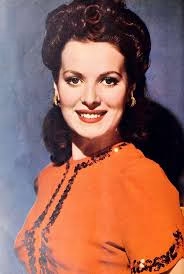
In the rolling green of County Meath, where ancient history meets modern pride, Kells claims a daughter who lit up the world’s silver screens: Maureen O’Hara.
With her fiery red hair and fierce Irish spirit, she captivated audiences in classics like The Quiet Man, but her heart always held a piece of Kells, the hometown of her father, Charles Stewart Parnell FitzSimons. In 2012, at the age of 91, Maureen returned to this heritage town for a homecoming that would etch her name into its story forever, when Kells bestowed upon her the Freedom of the Town—a tribute to a woman who carried its legacy across the Atlantic and back.
Maureen’s connection to Kells began with her father, born in 1885 to farming folk just outside the town. Charles was one of 13 sons of Bartholomew Fitzsimons, a blacksmith and farrier on Suffolk Street, and Bridget Tormay, who raised 10 surviving children. In her memoir ’Tis Herself’, Maureen recalls her “Daddy” as a decent, honest man whose practical roots shaped her own resilience. “It was a country farm, and many hands were needed to keep it running smoothly,” she wrote, painting a picture of a hardworking Kells family.
Charles, though, had a rebellious streak—his true passion was soccer, not the Gaelic football of his peers. Caught at a soccer match, he fell victim to the infamous GAA “ban,” was kicked off his team, and swore off Gaelic games forever. He later bought into Shamrock Rovers, a club Maureen would cheer for her whole life.
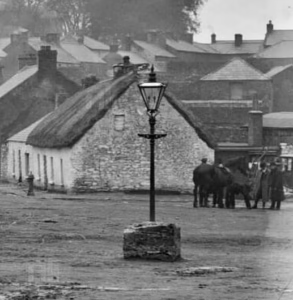
Though born in Dublin’s Ranelagh suburb on August 17, 1920, to Charles and Marguerita Lilburn FitzSimons, Maureen’s ties to Kells were a constant thread. She often returned to visit her uncle Frank, the last blacksmith on Farrell Street, whose forge blazed hot even on the coldest days. “I was born in Dublin, but my dad was a fiercely proud Meath man,” she once said, and her trips to Kells to see Frank and her many relatives—some of whom still live in the area—kept that pride alive. These visits weren’t just family reunions; they were a homecoming to the place that shaped her father’s character and, in turn, her own.
Maureen’s journey from Ranelagh to Hollywood is the stuff of legend. Trained in elocution, drama, and dance, she joined the Rathmines Theatre Company at 10 and the Abbey Theatre at 14, sweeping floors before stepping into the spotlight. At 17, she caught the eye of Charles Laughton, who signed her to Mayflower Pictures, launching her into films like Jamaica Inn (1939) and The Hunchback of Notre Dame (1939).
Renamed Maureen O’Hara—her FitzSimons surname deemed too long for marquees—she became a Technicolor queen, starring opposite icons like John Wayne, Tyrone Power, and Jimmy Stewart.
In May 2012, Kells welcomed its most famous daughter home with a festival that drew hundreds to its streets. The Maureen O’Hara Homecoming Committee, in collaboration with the Town Council, organised a celebration of her life and legacy. On May 26, despite needing a wheelchair, the 91-year-old unveiled a bust of herself near Farrell Street and Bective Square, crafted from a movie still that captured her timeless beauty. The sculptor was local and talented lady Betty Newman-Maguire.
“This is the first sculpture I’ve ever seen of myself,” she remarked, “and I was taken aback by how lifelike it is. Mind you, I don’t quite look like that now!”
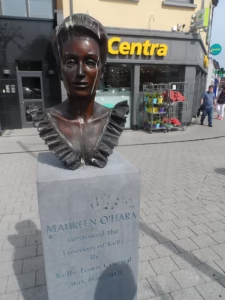
The crowd laughed, charmed by her wit. That evening, she attended a dinner dance—where locals noted how well she looked—and watched a match between Kells/Blackwater and Shamrock Rovers, a nod to her father’s soccer legacy.
The pinnacle of the festival came when Kells Town Council, led by Cathaoirleach Brian Collins, granted her the Freedom of the Town. “As a daughter of the town, Maureen O’Hara has brought pride to her many relatives in the area and to the town in general,” the organising committee declared. “Despite her legendary career and great success, she is still this town’s most distinguished daughter.” The honour celebrated not just her Hollywood triumphs—five films with John Ford, an Honorary Oscar in 2014—but her unwavering connection to Kells.
An exhibition by the Kells Social History Group during National Heritage Week that year also paired her story with that of Richard “Dick” Farrelly, the Kells man who wrote The Quiet Man’s haunting theme, The Isle of Innisfree, on a bus from Dublin to Kells.
Maureen’s bond with The Quiet Man resonated beyond Kells. At the Quiet Man Festival in Cong, Co. Mayo, Meath musician Maria Butterly performed her original song “Quiet Man,” inspired by Maureen’s fiery Mary Kate Danaher, for the star herself. With dignitaries like Dana and John Wayne’s daughter Marissa in attendance, Maria’s tribute—soon recorded at Cauldron Studios—echoed Maureen’s Meath roots. Brian Downes, director of John Wayne’s Birthplace Museum, later featured the song in U.S. festivities, cementing Maureen’s transatlantic legacy.
Maureen O’Hara passed away peacefully in her sleep on October 24, 2015, at 95, in Boise, Idaho, surrounded by family. Yet her spirit lingers in Kells. Visitors can stand by her bust, trace her father’s footsteps on Farrell Street, and feel the pride of a town that cherishes its Hollywood daughter.
From the farm fields of her ancestors to the forge of her uncle Frank, Kells shaped the woman who became Ireland’s first Hollywood star—a Freewoman of Kells whose light still shines.