
Ancient Origins
The origins of hurling are unclear and lost in history. The earliest written accounts can be found in Irish mythology, particularly in the stories of Cú Chulainn. According to these tales, Setanta (who later became known as Cú Chulainn) defended himself using a hurley and sliotar when he killed Culann’s fierce hound, earning him his legendary name.
But was hurling merely a pastime for warriors, or did it hold a deeper significance? Historians suggest that different cultures had their own versions of stick-and-ball games, but hurling took on a special meaning in Ireland. It was played not just as a sport, but also as a way to showcase strength, agility, and readiness for battle. The oldest archaeological evidence we have includes hurling balls made from tightly packed cow hair, which were discovered in bogs and date back over a thousand years.
The South Cross in Kells: A Hidden Hurling Tale?
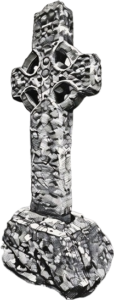
In Kells, where history is carved in stone, the South Cross holds an intriguing mystery. Scholars have argued over whether one of its panels, commonly thought to portray the biblical tale of David defeating the lion, might actually depict an ancient hurler. Some interpretations propose that David, instead of using a sling, is possibly gripping a hurley—an interesting reference to the significance of hurling in early Irish culture.
Hurling and the Exile of Colmcille
Hurling also played an unexpected role in one of the most significant moments in Irish history—the exile of Colmcille.
The story unfolds at the court of High King Diarmaid in Tara, where a young prince named Curnan of Connacht was under Colmcille’s protection. During a hurling match, a violent clash erupted, and in the heat of the moment, Curnan struck and killed another boy—who happened to be the son of Diarmaid’s chief steward. Fearing retribution, Curnan sought sanctuary with Colmcille. But Diarmaid, eager to assert his authority, violated the sacred law of protection and had the boy executed.
Outraged by this breach of sanctuary, Colmcille turned to his powerful Northern Uí Néill kinsmen, rallying them against the High King. The resulting conflict—known as the Battle of Cúl Dreimhne—saw Colmcille’s forces victorious, but at a heavy cost: thousands lay dead. Though victorious, Colmcille was deeply shaken by the bloodshed. A church synod later condemned his role in the conflict, and as penance, he chose exile, setting sail for Iona in 563 AD. There, he founded the great monastic settlement that would spread Irish learning and influence across Scotland and beyond.
Hurling Today: A Living Tradition
During periods of British rule, hurling was repeatedly suppressed, as it was seen as both a form of resistance and a way to cultivate Irish identity. Laws were enacted to discourage the playing of hurling, with restrictions placed on gatherings and the carrying of hurley sticks.
Despite these efforts, the game persisted in rural communities, kept alive by local traditions and determined players.
The Gaelic Athletic Association (GAA), founded in 1884, played a critical role in the revival and formalisation of hurling. The organisation provided structure, standardising the rules of hurling and fostering a competitive spirit through county leagues and championships.
From its legendary past to the present, hurling remains at the heart of Irish culture. It is played with the same fierce passion in county finals as it was in the ancient fields of Tara and Kells.
For those eager to experience the thrill of the game, why not try it for yourself? Under ‘5 Must-Do Experiences in Kells’ on KellsAwaits.ie, you’ll find Causey Farm’s ‘Be Irish for a Day’ experience, where visitors can take up the hurl, swing for a sliotar, and step into the shoes of Ireland’s ancient warriors.
Hurling is not just a sport. It’s a living story—one that began thousands of years ago and continues to be written with every clash of the ash today.
Comments