
Headfort House

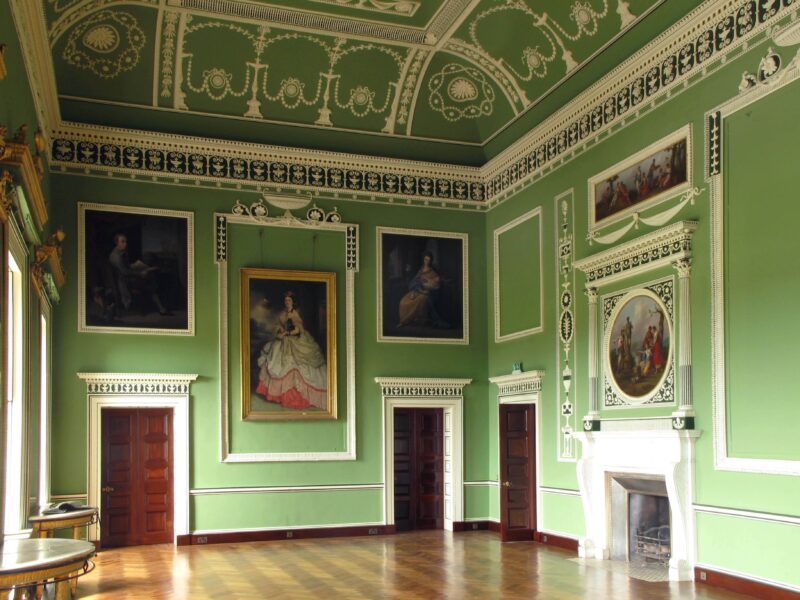
Headfort House, located on the south side of Kells in County Meath, Ireland, is a large country house with an historic and architectural heritage. Built in the 1760s for Sir Thomas Taylour, later the 1st Earl of Bective (1724-1795), the house was designed by Dublin architect George Semple. Located above the River Blackwater, a river that flows into the River Boyne, and located just beyond the historic ecclesiastical town of Kells.
Architectural Design and Landscape
Headfort House entry from Kells is marked by high demesne walls and a triple-arched bridge, which was created by Thomas Cooley. Entry gates, also by Cooley, lead to a woodland avenue to the house, passing over stable buildings that have been repurposed for living.
Headfort House was renowned for its Capability Brown-style parkland, which featured mature woodland plantations, a serpentine lake with artificial islands featuring Asiatic trees, and a large parterre lawn with hedges of topiary clipped round viewed over by the rear of the house. The parkland has in recent years been developed over as a golf course.
The structure used local grey Ardbraccan limestone and is a three-over-basement 11-bay building with a three-bay central breakfront and two-bay terminal breakfronts on its entrance front. It features a three-bay central breakfront with sweeping steps to the parterre lawn on its garden front. Long single-storey wings project from either side of the house.
Interior Masterpiece by Robert Adam
From 1771 until 1775, the noted Scottish architect Robert Adam was retained to design a suite of rooms for the newly completed house. Adam’s commission involved the entrance and staircase halls, and an enfilade of garden-front rooms culminating in a double-height ‘Eating Parlor’ with a flat coved ceiling.
The ‘Eating Parlor’ is a large room formed by the joining of two rooms on the ground floor with the rooms above on the first floor. It is furnished with pier glasses and tables between four windows, twin chimney pieces with overmantles containing classical paintings by Antonio Zucchi, wall panels with portraits, and matching doorcases.
Adjoining the ‘Eating Parlor’ is the Saloon, which bears a painted medallion of Bacchus and Ariadne and eight minor medallions of ancient figures surrounding them. The Chinese Drawing Room, hitherto furnished with three landscape papers, adjoins this suite but the original papers do not remain.
Adam’s staircase hall was originally meant to be more elaborate, but only his ceiling designs were incorporated in the final version, with the original simple mahogany staircase preserved but supplemented by mouldings. Similarly, Adam’s entrance hall designs were reduced, but the room still has a distinctive decorative ceiling.
Historical Significance and Evolution
The Taylour family, Marquesses of Headfort, owned the house privately until 1949, when the main house was leased to Headfort School, and the family relocated to the East Wing, renamed Headfort Court. The 6th Marquess then sold the East Wing and the school grounds to American B.J. Kruger in the 1980s so that the school could continue to operate.
When Kruger passed away, the estate was divided, with the East Wing as a distinct property, and the rest of the house and grounds were bought by the Headfort Trust, a charity dedicated to preserving the buildings and paying for the school.
Conservation and Recognition
Headfort House was added to the World Monuments Fund’s list of the 100 Most Endangered Sites for 2004, generating vital fundraising opportunities. The Headfort Trust initiated principal repairs like roofing and chimney rebuilding, structural damp proofing, and conservation work on the historic interiors.
Careful study of Adam’s original decoration plans was carried out by historic interiors specialist Richard Ireland. Hundreds of microscopic analyses of paint samples showing subtle verdigris color schemes in the ‘Eating Parlor’ and different color palettes elsewhere, including mid-green verdigris, violet, brown, and white in the Chinese room, and mid-grey and white in the entrance hall, reflecting a Palladian influence, were among them.
Legacy and Present Day
Headfort House is one of Ireland’s great houses on the basis of its historical and architectural significance, particularly the interiors by Robert Adam, which are among the most important of his work in Ireland. Adam rarely became engaged in Irish commissions, and the interiors at Headfort are especially important as they represent the most significant of his three Irish schemes.
Today, the parkland surrounding it is in the hands of a golf club, but the house itself belongs to the Headfort Trust and remains leased out to the long-established Headfort School, which reopened under new ownership in September 2020 following a temporary closure in March 2020. The ongoing preservation and conservation efforts guarantee this historic and architectural treasure to remain a significant cultural landmark.
Visits are by arrangement only.