
The Tailteann Fair (Aonach Tailteann)

The Tailteann Games: Ireland’s Ancient Festival of Sport & Culture
A Celebration of Strength, Skill, and Tradition
Long before the Olympic Games of Ancient Greece, Ireland had its own grand athletic and cultural festival – the Aonach Tailteann or Teltown Fair.
Held at Teltown, outside of Kells, this historic gathering brought together warriors, athletes, and artisans in a vibrant celebration of strength, skill, and storytelling. Over centuries, the festival evolved, reflecting Ireland’s shifting dynasties and traditions, yet its echoes remain in modern Irish culture.
The Origins of the Tailteann Games
The roots of the Tailteann Games stretch deep into Ireland’s mythological past. According to legend, the festival was founded by the hero Lugh Lámhfhada (Lugh of the Long Arm) in honour of his foster mother, Queen Tailtiu. She was said to have died of exhaustion after clearing the land for agriculture, and in her memory, Lugh declared that a great assembly, the Aonach Tailteann, should be held at Teltown in the autumn.
The festival took place every three years and lasted over 2 weeks, ending on the 1st of August, marking the harvest festival of Lughnasa, a time of abundance and renewal.
The Gaelic word for August is Lughnasa, named after Lugh.
Irish playwright T.H. described how the Irish games are older than the Ancient Greek Olympics, and served as inspiration for the Greek events later. He said,
“…not merely the idea of the games, but the actual games themselves, their sequence at the festivities, the rules under which the various contests were held, and even the very bye-laws regulating the conduct of the people before, during and immediately after the celebrations, were all borrowed en masse from those already in operations in [Ireland].”
Historians differ in opinions as to when the first Aonach Tailteann was held.
Some sources put it back as far as 1823 B.C.E., others as recently as 622 B.C.E. What is generally agreed upon, however, is that the last Aonach Tailteann took place around the time of the Norman invasion of Ireland, around 1170 C.E.. This final assembly was hosted by Ruaidrí Ua Conchobair (Roderick, or Rory O’Connor), the last High King of Ireland.
To give a scope to the size of the games, during this last Aonach, the horse and chariot traffic extended over 6 miles from Tailtiu to Mullach-Aiti (‘Hill of Lloyd’) near Kells, where now the Spire of Lloyd stands.
A Festival of Sport, Art, and Law
The Aonach Tailteann was more than just a sporting event—it was a political and cultural gathering of great importance. Here political alliances were forged and strengthened. The kings used the Aonach Tailteann as a period in which new laws were established, older ones were modified, and everyone was advised as to what these mandates actually were.
Noblemen would take this information from the High King back to their own lands, spread the word, and thus everyone was following the same set of rules. Kings might use this assembly as a time to ask fealty of their men, and oath-taking was likely a regular component of the gathering.
The Games themselves included:
- Chariot and horse racing
- Running, jumping, wrestling, and boxing
- Spear throwing, archery, and sword contests
- The first mention of pole vaulting (originally a game of jumping over rivers)
- Swimming and rowing
- Hurling and other traditional Irish sports
- Poetry, music, and oration competitions
- Artisan showcases for weavers, goldsmiths, and weapon makers
The Aonach Tailteann was held under strict laws, ensuring peace during the festival. Crimes were punished severely, and feuds were set aside for the duration of the Aonach. Remarkably, women were not excluded, and matchmaking ceremonies known as “Teltown Marriages” were a key feature of the event.
Cúán úa Lothcháin, an 11th century Irish poet, wrote a verse celebrating the return of the games in 1006 C.E., after a hiatus of nearly eight decades. He wrote:
A Fair with gold and silver,
With games, with music of chariots,
With adornment of body and soul
By means of knowledge and eloquence.
A Fair without wounding or robbing of any man,
Without trouble without dispute
Without reaving, without challenge of property,
Without suing, without law sessions,
Without evasion, without arrest.
A Fair without sin, without fraud,
Without reproach, without insult,
Without contention, without seizure,
Without theft, without redemption.
No man going into the seats of the women,
nor woman into the seats of the men, shining fair,
But each in due order by rank,
In his place in the high Fair.
Finally, the Aonach Tailteann was a time to honour the dead. Funeral celebrations were held for the recently deceased, depending on the level of their social status, and songs were sung in their memory. Priests performed elaborate rituals, and funeral pyres were burnt.
The Decline and Revivals
The Norman invasion of Ireland in 1169 ended the long tenure of the Tailteann Games. However, in 1924, the tradition was renewed. In the early 1920s, Ireland was emerging from the Irish War of Independence and then the Irish Civil War, the latter in particular coming at a heavy psychological cost for the new free state. Proposed in 1922 and first held two years later, the resurrected Tailteann Games celebrated Ireland’s sovereignty, as well as helped promote its culture on the world stage.
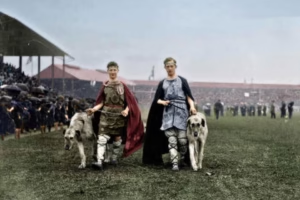
One of the unique aspects of the revived Tailteann Games was the participation of athletes from around the world. Unlike their ancient predecessors, which were primarily a local affair, the modern Tailteann Games welcomed competitors from the Irish diaspora and from countries with no historical ties to Ireland. Athletes from the United States, Canada, Australia, South Africa, and parts of Europe competed, bringing an international flair to the events. This not only helped to elevate the profile of the games but also fostered a sense of unity and celebration of Irish identity worldwide.
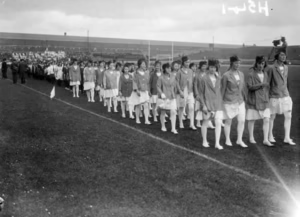
The organisers of the event made sure the Tailteann Games coincided with the Olympics in order to attract athletes and tourists from that event. Because the 1924 Olympics were held in Paris and four years later in Amsterdam, many gold medal athletes travelled to Ireland for the Tailteann Games, bringing the event to 6,500 competitors in the first year. The revival included a broad range of sports, some of which were traditional Irish games like hurling, Gaelic football, and camogie, as well as more globally recognised sports like athletics, boxing, and cycling. Akin to the original Tailteann Games, there were also various competitions in the arts, such as music, dance, and art, echoing the ancient tradition of celebrating all aspects of culture.
Although the Tailteann Games were a remarkable achievement for the young nation, they were also short-lived. The 1928 competition was another success, with the awards ceremony being held in Iveagh Gardens, Dublin. However, the event lost steam in the 1932 iteration. The Olympics were located in Los Angeles that year and many athletes thought it too far to travel to Ireland afterwards. Also, the competition created a significant financial deficit that had to be dealt with. The games were ultimately reduced from two weeks to one. The Tailteann Games were planned for 1936, but funding was not available for the project.
Exploring the Tailteann Donaghpatrick Landscape Today
Though the grand festival is no longer celebrated, visitors can still explore the historic landscape where it once flourished. Several key sites remain at Teltown:
Rath Dubh (Rathdhú) – The Central Mound
(Knock at the door of Gerry O’Brien next door and he will show you round)

A large circular earthwork, once surrounded by a low rampart where spectators sat to watch the games. Though much of it has been lost to time, the mound still stands, offering panoramic views of the surrounding countryside.
Rath Airthir – The Eastern Fort
(Can be seen from the road)
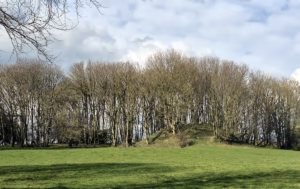
Rath Airthir, meaning “Eastern Fort,” is a significant trivallate enclosure (a ring fort with three banks and ditches). Thought to have been the royal assembly site of the Tailteann festival, it may have housed a large feasting hall. The mound at its center is a barrow (burial mound) rather than a Norman motte, though it is possible that later modifications were made. Some believe it could even be the burial site of Queen Tailtiu herself. This was a key stronghold of the Síl nÁedo Sláine kings, with connections to the High Kingship of Tara. Today, visitors can view it from the road, but access requires permission from the adjacent property owner.
And Lugh buried her (Tailtiu) in the plain of Midhe [Meath], and raised a mound over her, that is to be seen to this day. And he ordered fires to be kindled, and keening [mourning] to be made, and games and sports to be held in the summer of every year out of respect to her.
And the place they were held got its name from her, that is Taillten (Telltown).”
– Lady Gregory, Gods and Fighting Men
Donaghpatrick Church

Just across the road from Rath Airthir stands Donaghpatrick Church, perched on a gentle rise overlooking the Blackwater River.
Legend has it that St. Patrick himself passed through Tailteann during the great royal games in the mid 5th century. But not all were welcoming. Coirpre, brother of High King Laoghaire of Tara, took offence at the saint’s presence.
Coirpre, Conall and Laoghaire were sons of the legendary Niall of the Nine Hostages.
Enraged, Coirpre had Patrick’s followers beaten and thrown into the River Sele. Patrick, unshaken, declared Coirpre an “enemy of God” and prophesied that none of his descendants would ever sit on the throne. He also cursed the river, and from that day forward, its waters darkened—hence the name we know today: Abhainn Dubh, the Blackwater.
Coirpre’s brother, Conall, welcomed Patrick with great joy at his home, where the church stands today, and Patrick baptised him in the Blackwater River. After his baptism, Conall granted this land to St. Patrick to build a church. And it stood strong, though it bore the brunt of history—burned or plundered at least six times between 745 and 1156 AD, first by Viking raiders and finally by Diarmuid MacMurrough, the King of Leinster.
Cill Tailteann
(at the back of Teltown House; contact them for access)
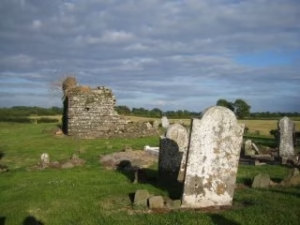
An ancient cobbled path leads to the old graveyard where you will find the base of a cross and the ruins of a medieval church. In recent times, Professor George Eogan uncovered Rock Art dating back to 2,000 B.C.E. on a natural rock outcrop indicating Neolithic Stone Age activity in the area. The church was plundered by Diarmuid MacMurrough and the Danes in 1156 and again in 1170 by Diarmuid.
Access can be sought at Teltown House itself, and on the first Sunday of the month (April to November) when the car boot sales are on.
The Knockauns – Teltown Marriages
(Can only be seen from the road as they are at the back of a property.)
A set of parallel earthen banks believed to be the site of the famous Teltown Marriages.
These unions were arranged by young couples who joined hands through a hole in a wooden gate. If unhappy after a year and a day, they could separate by walking away from each other on Rathdhú, on the Hills or Mounds of Separation.
This trial had many benefits from a social standpoint: status was important at the time, and separating at the end of a trial period would maintain the good standing of both people in the eyes of the community. This also ensured equal division of property and/or land where necessary, which would come as a great relief for all involved, but more so for the husband.
Under Brehon Law, the wife could more easily obtain a divorce on grounds such as infidelity or the husband ‘not pulling his weight’ as a provider. As long as she could prove her worth as a housewife and earner for the family, she would retain her land and property and claim as much of his own property as her status would allow.
The ‘Tailteann marriages’ were a staple of the Games from their inception, and remained legal in Ireland until the 13th century.
The Irish historian John O’Donovan (1806-1861) wrote the following on the Tailteann Marriages:
“A number of young men went into the hollow to the north side of the wall, and an equal number of marriageable young women to the south side of the wall which was so high as to prevent them from seeing the men; one of the women put her hand through the hole in the gate and a man took hold of it from the other side, being guided in his choice only by the appearance of the hand. The two were thus joined hands by blind chance and were obliged to live together for a year and a day, at the expiration of which time they appeared at the Rath of Telton and if they were not satisfied with each other they obtained a deed of separation, and were entitled to go to Laganeeny again to try their good fortune for the ensuing year.”
A subsequent writer described the way of ending the marriage. The couple would stand back to back on a nearby earthen fort and walk away from each other – just as in the kirk of Stenness (Orkney Islands).
Sources:
- Máire MacNeil, The Festival of Lughnasa, 1962
- Paul Gosling, Teltown, Co. Meath: Máire MacNeill’s ‘principal old road’ and the topography of Óenach Tailten, 2017
- John O’Donovan, Annals of the Kingdom of Ireland by the Four Masters, 1848
- T. H. Nally, The Aonach Tailteann and the Tailteann Games – Their Origin, History and Ancient Associations, 1922
- Catherine Swift, The local context of Oenach Tailteann, 2000
- T. M. Charles-Edwards, Early Christian Ireland, 2004
- Lebor Gabála Érenn (The Book of Invasions)