
 Kells is an old town. It has some of Ireland’s best early Christian High Crosses. These huge stone monuments date back to the 9th century. They show Ireland’s strong monastic history. There were 5 crosses at the Monastic Site entrances. Here’s a guide to the famous High Crosses of Kells:
1. The Market Cross (The Cross of the Gate)
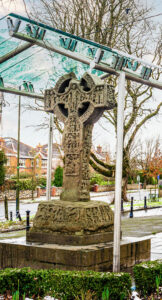
The Market Cross stands outside the Kells Courthouse Tourism & Culture Hub. This large cross was once used for town announcements at the Kells Castle market, and was located further up the town, near the eastern gate of the monastery. Passing the cross meant you could claim sanctuary. But the cross was moved to its current location to protect it from traffic.
The cross is carved from sandstone. It shows scenes from the Bible, like the Fall of Man, the Sacrifice of Isaac, and the Crucifixion. The arms even have images of St. Paul and St. Anthony, which is very rare for Irish high crosses. The base is decorated with horsemen, hunting scenes, and mythical creatures. This links the cross to the skilled stonemasons of Durrow and Monasterboice.
Through the years, the cross has been moved, damaged, and even hit by a bus in 1996. Yet, it is still a strong symbol of Kells’ medieval past and ability to endure.
A visit to Kells isn’t complete without seeing the Market Cross!
2. The South Cross (Cross of St. Patrick & St. Columba)
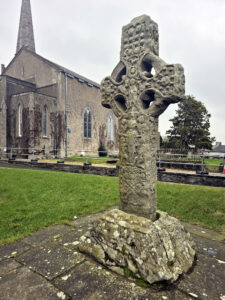
Standing next to Kells’ Round Tower, the South Cross is the oldest high cross in the town. This cross dates back to the 9th century. It is carved from one piece of sandstone and stands 3.3 meters tall. The cross is decorated with some of the best carvings from that time period.
The base has a Latin inscription that says “PATRICII ET COLUMBAE CRUX“. This means it is Patrick and Columba’s Cross. The cross shows a transition between old decorative styles and later biblical scenes. It guides the viewer through a visual story of faith and tradition.
The east side has figures like Adam and Eve, Cain and Abel, Daniel with lions, and three Hebrews in a fiery furnace.
The west side shows a large Crucifixion, with the sun and moon above Christ’s arms. The four Gospel writers are around the top of the cross. The arms have Isaac’s sacrifice and the miracle of loaves and fishes.
At the base, two figures show an old Irish tradition. Intricate details like chariots and hunting scenes finish this great work. The South Cross is both an artistic wonder and a symbol of Ireland’s medieval past.
3. The East Cross (Unfinished Cross)
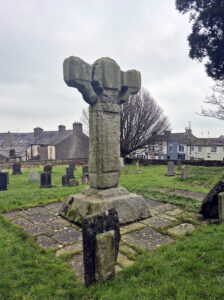
Standing tall at 4.75 metres, the Unfinished Cross — also known as the East Cross — overlooks the ancient graveyard beside St. Columba’s Church.
This cross offers a rare glimpse into the craftsmanship behind Ireland’s High Crosses.
Carved on-site in the 9th or 10th century, the cross remains incomplete, with visible rectangular panels marked out for carving but never finished. A Crucifixion scene at its centre was nearly completed, while a delicate key-pattern on the underside of the south ring was just beginning to take shape.
One theory suggests that Viking raids in Kells disrupted the monastery’s artisans, leaving their masterpiece unfinished.
For centuries, the cross lay in fragments before being reassembled in the late 19th century.
4. The West Cross (Broken or Ruined Cross)
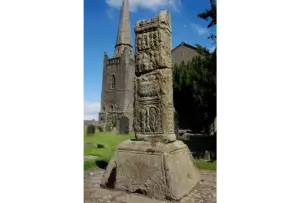
The West Cross (Broken Cross or Ruined Cross)
Located at the western end of Kells’ graveyard, the West Cross is one of the town’s five high crosses. Although it is now in ruins, it still stands as one of Ireland’s finest crosses, evoking both admiration and regret. It was once believed to be the tallest cross of its kind at 3.5 meters. However, it may have been vandalised by Cromwell’s soldiers in the 17th century and later re-erected—possibly facing the wrong way.
The West Cross dates back to the 9th or 10th century and features intricate carvings depicting biblical scenes. The west face showcases Adam and Eve, Noah’s Ark, the Crucifixion, and Christ in majesty. On the other hand, the east face illustrates various events from Christ’s life, including the Marriage at Cana, His baptism, and His entry into Jerusalem.
Despite being weathered over time, the cross still displays beautiful spirals, knotwork, and ornate panels—silent testimony to Kells’ rich monastic past.
5. The North Cross (Base)
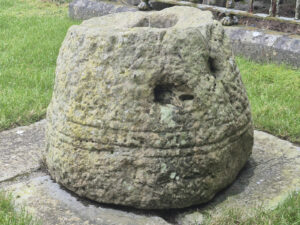
All that remains of this cross is the base, that has bands of interlace that run horizontally with raised bands between.

Other Landmarks to Explore
In addition to the High Crosses, Kells is home to several must-visit historical sites:
- Colmcille’s House – A 9th-century stone oratory believed to have been used as a scriptorium for creating manuscripts like the Book of Kells.
- The Round Tower – A well-preserved 10th-century tower that once served as a refuge for monks during Viking raids.
Comments