
A Survivor of Turbulent Times: The Remarkable Journey of the Book of Kells
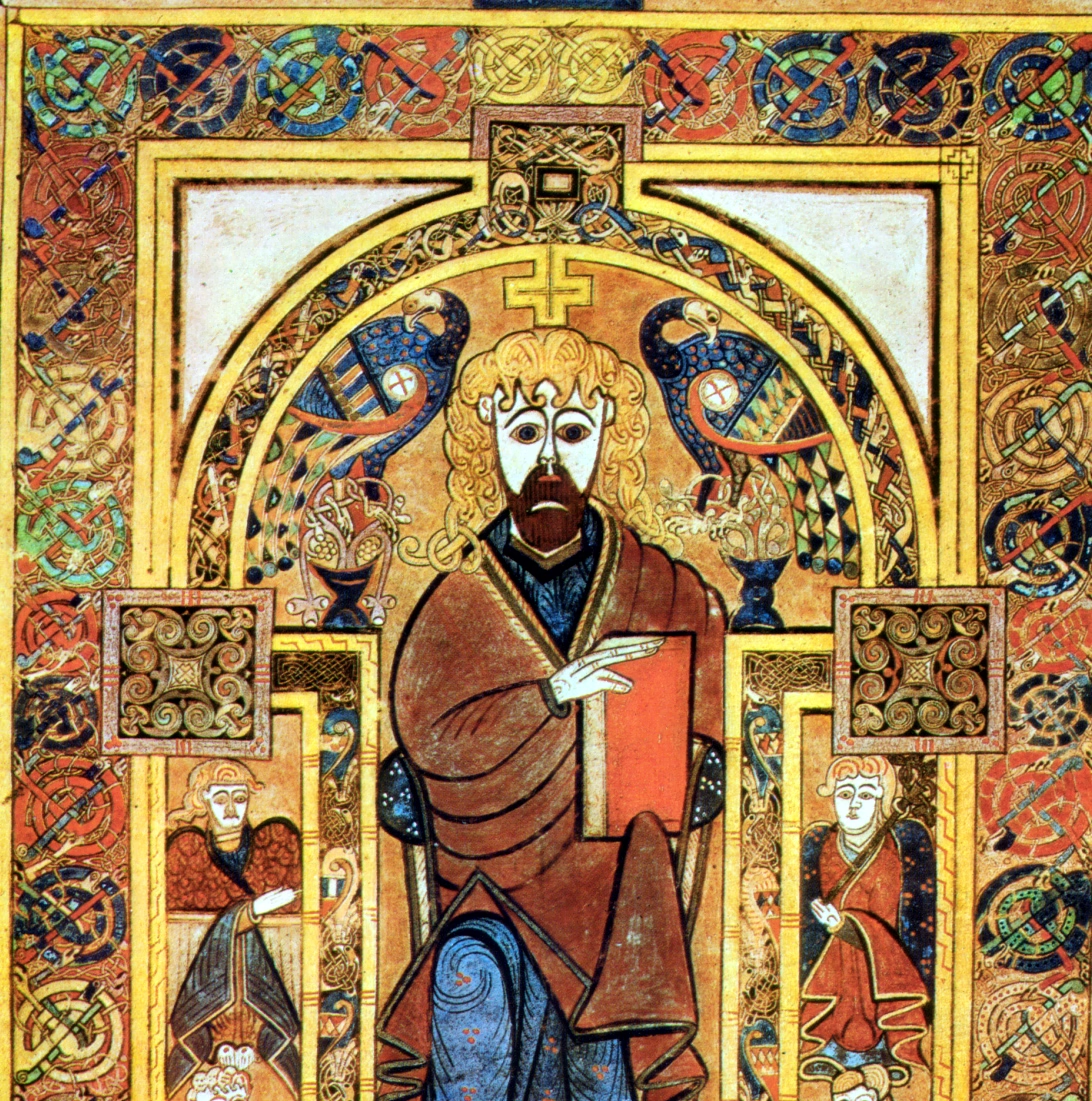
800: Creating Under Duress
According to one popular tradition, the Book of Kells was begun somewhere on the island of Iona, at the monastery founded by St. Colmcille (Columba). During this time, monasteries served as schools of learning and spirituality, where monks dedicated their lives to creating and preserving sacred texts.
These monastic sanctuaries had always provided ample temptation for Viking raids with all their valuable portable goods, like beautifully wrought crucifixes and chalices, but as an island monastery, Iona was particularly vulnerable. In 806, nearly seventy monks were killed in a savage Viking invasion; those who survived chose to retreat to avoid further bloodshed. Threatened by these raids, they took the relics of Columcille to Ireland for safekeeping.
They certainly would have brought the Book of Kells, or perhaps it was taken to Ireland later when other treasures, led by “the shrine and precious objects of Colum Cille,” were transferred to escape looting by the Norse. Whatever the actual date of its nautical transit may be, it is important to note that it navigated the tumultuous ocean—an extremely forbidding voyage. Other relics of St. Colum Cille and St. Patrick were lost at sea in 1034 during a similar crossing, highlighting just how narrowly the Book of Kells escaped being lost forever to the ocean’s depths.
1006: Theft and Miraculous Recovery
Once it reached Ireland, the manuscript was protected at the monastery in Kells as both a holy work and a relic of St. Columcille. For a very long time, it was known as the Great Gospel Book of Colum Cille.
This sanctuary, however, could not shield it from the glare of avarice. In 1007, the Book of Kells was stolen from the stone church in Kells, according to an entry in the Annals of Ulster. The chronicle described the theft as follows:
The great Gospel of Colum Cille was sacrilegiously stolen in the night from the western sacristy of the church of Cennanas. It was the most precious object of the Western world, on account of its covers with human forms.
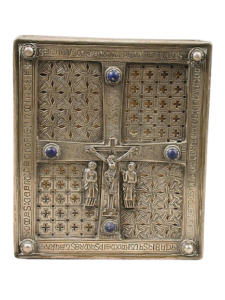
This Gospel was recovered after two months and 20 nights, its gold having been taken off it and with “a sod over tablemat”. Around sixty pages were lost, yet the manuscript survived.
1653: Great War and Rescue
The most dangerous time for the manuscript was during the wars in Ireland in the mid-17th century. In 1641, the church at Kells was destroyed during a rebellion. Later, in the 1650s, it faced desecration when Oliver Cromwell’s soldiers occupied the area. Recognising the danger, Charles Lambert, the Earl of Cavan and governor of Kells, sent the Book of Kells to Dublin Castle for safekeeping in 1653.
Eventually, it was brought to Trinity College, Dublin by Henry Jones, a former scoutmaster general for Cromwell’s army who later became Bishop of Meath.
1660s to Present: Preservation at Trinity College Dublin
By the 1660s, the Book of Kells found a permanent home at Trinity College, Dublin. Since the mid-19th century, it has been on display at the Old Library of Trinity College, attracting over 900,000 visitors in 2024.
The manuscript has been rebound several times. In 1826, the manuscript was entrusted into the care of binder George Mullen Jnr. Belonging to an era when ‘tidiness’ was the preferred aesthetic, Mullen’s intervention has since been described as ‘disastrous’.
Mullen first washed the manuscript, causing the pages to shrink unevenly, and then pressed them together to flatten them, causing considerable loss of colour. He then painted some of the margins with white oil paint and filled and tinted flaws in the vellum. Worst of all, he trimmed the formerly uneven edges of the manuscript so that the edges could be gilded, removing parts of decoration of some of the pages in the process.
1874: A Second Modern Disappearance
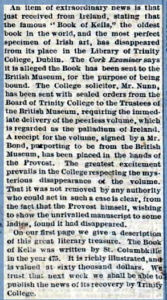
The Book of Kells was reported missing once more in 1874. According to the Birmingham Daily Post, Trinity College was in despair when the manuscript was discovered missing. It was last seen when the Provost of Trinity College had wished to show it to some visitors, but no one could recall when it was last viewed, and the librarian was unavailable for questioning.
Rumours swirled, and the Birmingham Daily Post revelled in a further layer of mystery: “A receipt for the volume signed by a Mr. BOND, purporting to be from the British Museum, has been placed in the hands of the Provost.”
Within a week the manuscript was located. The librarian of Trinity College, J. A. Malet, had himself taken it to the British Museum in London for advice on rebinding. The College sent its lawyer to London to demand its return, and the manuscript was hastened indignantly back to Ireland.
This brief disappearance, though not as dramatic as the earlier thefts, only added to the Book of Kells’ legendary history.
Survivor Against All Odds
The fact that the Book of Kells has survived is nothing short of a miracle. Many other illuminated manuscripts didn’t make it through perilous sea journeys, medieval wars, Viking attacks, fires, theft, neglect, or Cromwell’s destruction. Experts believe that only about ten percent of all medieval manuscripts have survived.
Visitors to the Old Library of Trinity College can experience this living testament through the engaging Book of Kells Experience—a homage to a manuscript, the Book of Kells, a survivor of turbulent times, which continues to inspire generations.