
Buildings of Kells: Williamstown House

Williamstown House – The Rise and Ruin of a Big House Dream
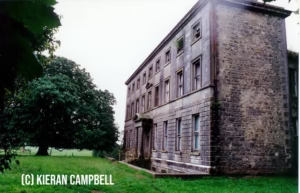
Perched quietly in the townlands just outside Kells, the once-grand Williamstown House is crumbling into memory. But its story still echoes through time – a cautionary tale of ambition, inheritance, and the weight of legacy.
This stately home began life in the 1770s, built in Palladian splendour by the Reverend Hamilton Cuffe and his wife Esther Williams. Esther had inherited the land from her father Thomas (and mother Dorothea) – part of the Williams family estate, who’d first acquired the lands from the Taylor family of Headfort in the late 1600s. Like many “Big House” owners of the time, the Cuffes borrowed heavily to finance the build – and they weren’t the last to do so.
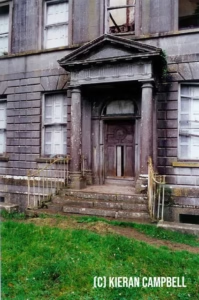
The house they raised was a limestone-fronted mansion of five bays, three storeys over basement, with fine Doric columns framing the entrance. But grandeur came at a cost. By 1806, so deep were the debts that even Trinity College Dublin stepped in to recover unpaid loans. When Rev. Cuffe died just a few years later, the family had already left Williamstown behind.
A new chapter began in 1828, when wealthy heiress Sarah Garnett bought the estate – only to pass away shortly after. Her cousin, Rev. George Garnett, inherited it, and the cycle repeated: land-rich but cash-poor, he raised mortgages and struggled to support his eight children. His son, William Stawell Garnett, extended the house to a striking nine bays, redecorated its interiors in Victorian style, and added a lodge (now known as Zephyr Lodge), as a dower house for his widowed mother. But with debts mounting once again, the estate was auctioned off in 1880. Carriages, horses, dog houses and all.
From the 1880s onward, Williamstown House entered a period of change and quiet decline. A few tenants came and went – including Dr. Thomas Sparrow, the Kells dispensary doctor who lived there with just two servants in 1901, and later, the Shortridge family.
But it was the McCormicks who gave the house its final burst of life. John McCormick, drawn more to farming than coal shipping, bought Williamstown in 1912. He and his sister Rose moved in – but John tragically died just weeks after being deployed in WWI. Rose remained, managing the estate in her own way, with an ever-changing circle of guests and companions. Long before rural electrification, a water-powered generator installed by friend Cyril Bartholomew brought the first electricity in Kells to the house in the 1920s.
Despite occasional court cases over unpaid rent or thistle infestations, Rose lived a life full of spirit and stubborn pride. She farmed, hosted, and endured – until the 1970s, when she too passed away. And with her, Williamstown fell silent.
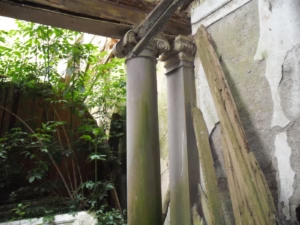
Today, the house is a haunting shell. Its back wall has collapsed, its great rooms open to the elements. But look closely, and you’ll still see the artistry – limestone dressings, timber sash windows, and the echoes of a house that once stood at the crossroads of history.
Further Reading:
“A History of Williamstown, Kells” by Dr. Liam McNiffe – local historian, retired principal of St. Patrick’s College, Cavan.