
St. Colmcille (St. Columba)
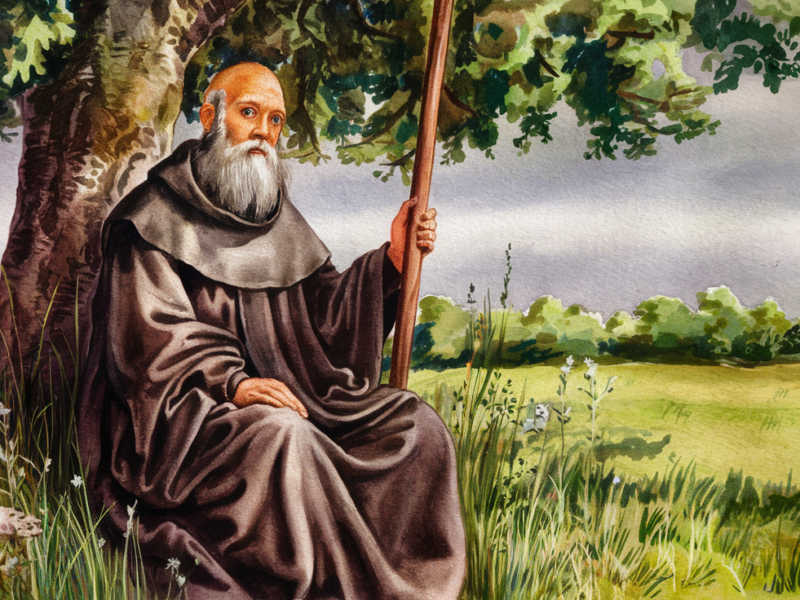
St. Colmcille, also known as Columba, (521 – 597 A.D.) was an influential Irish abbot and missionary who played a pivotal role in spreading Christianity in Ireland, Scotland, England and parts of Europe too. He is best known for founding the abbey on Iona, and revered as one of the Twelve Apostles of Ireland. He is one of Ireland’s three patron saints, the other two being St. Patrick and St. Brigid.
He was a towering, broad-shouldered figure with a deep, resonant voice said to carry from hilltop to hilltop.
He is celebrated for reviving monasticism in western Europe and is often depicted holding a basket of bread and an orb of the world bathed in a ray of light.
Early Life and Lineage
Colmcille was born on 7 December 521 in Gartan, Tír Chonaill (modern-day County Donegal, Ulster) to Fedlimid and Eithne of the powerful Cenél Conaill dynasty and clan. His father was a great-great-grandson of Niall of the Nine Hostages, a legendary Irish high king. Through this lineage, Colmcille was also related to Cormac mac Airt, another High King of Ireland, underscoring his noble heritage.
The name ‘Colmcille’ means ‘Dove of the Church’ in Irish. Some sources suggest his birth name was Crimthann (‘fox’), although others, including Adomnán of Iona, his biographer, believed Colmcille was his given name. He spent his early years in the remote area now known as Glencolmcille, named in his honor.
Education and Mentorship
Colmcille received his early education under prominent church figures in Ireland, immersing himself in Christian theology and Latin learning, which flourished in monastic schools at the time. His key mentors included:
- Finnian of Movilla: Colmcille began his formal education at the monastic school of Movilla, under Finnian, who had been trained in the Welsh tradition at Ninian’s monastery in Galloway. Here, Colmcille was introduced to Christian scholarship and Latin texts.
- Gemman: After Movilla, Colmcille studied under Gemman, an elderly bard in Leinster, where he gained skills in poetry and storytelling.
- Finnian of Clonard: He continued his education at Clonard Abbey on the River Boyne in County Meath, which was a renowned center of learning. Colmcille was one of Finnian’s twelve disciples who became known as the Twelve Apostles of Ireland.
- Mobhí Clárainech: Colmcille also studied at Mobhí’s monastery in Glasnevin, alongside notable figures like Cainnech of Aghaboe and Ciarán of Clonmacnoise. When a plague struck in 544, Colmcille returned to Ulster, his ancestral homeland.
Conflict and Exile
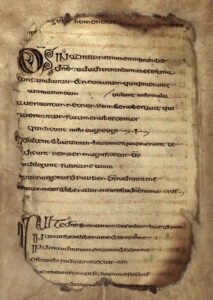
Around 560 AD, Colmcille became embroiled in a dispute with Finnian of Movilla Abbey over a psalter (traditionally said to be the Cathach of St. Columba). Colmcille had copied the manuscript at Finnian’s scriptorium, intending to keep the copy. Finnian heard about this, but he waited until it was finished, then told Colmcille that he couldn’t depart with it, but must hand it over!
The matter escalated, and was taken before the High King Diarmait mac Cerbaill, who ruled, “To every cow belongs her calf, therefore to every book belongs its copy.”This is known as the first copyright ruling in Western Europe.
Colmcille, however, disagreed with this ruling. It is said that he instigated a rebellion by the Uí Néill clan against the King, leading
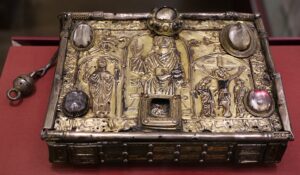
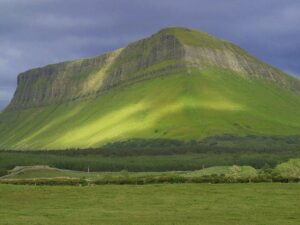
to the Battle of Cúl Dreimhne (561 AD) in the shadow of the mountain Ben Bulben in County Sligo, which resulted in around 3,000 casualties.
Another reason for the battle stems from the violation of sanctuary or termon. The Annals of Tighernach record the death of Prince Curnan, the son of Aed, King of Connacht, who was under Colmcille’s protection.
Prince Curnan fatally wounded a rival during a hurling match, a traditional Irish sport. Seeking refuge, the prince fled to Colmcille for sanctuary. However, Diarmaid’s men defied this protection, forcefully seizing the prince from the saint’s side and killing him. This violation may also have led to the conflict.
In the wake of the battle and Colmcille’s involvement, he was faced with judgment. A synod of priests and bishops was convened to judge whether Colmcille should have meddled in the affairs of the world or not, but they reached no conclusion after Brenadan of Birr spoke up in support of the Saint.
The synod suggested excommunication, but Colmcille’s own conscience was deeply troubled, and in his remorse he listened to the words of the hermit whose name was Molaise, and decided to leave Ireland, swearing never to set eyes on it again.
Colmcille and twelve of his followers got in a leather currach and set off from Stroove Beach on the Inishowen Peninsula for Scotland, and first landed in Kintyre, but he could still see Ireland from that spot, so he went away northwards along the west coast of Scotland to Iona.
Colmcille spent the remainder of his days trying to win as many souls for Christ as those that had perished in Battle of Cúl Dreimhne.
Mission in Scotland
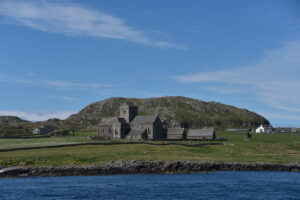
In 563 AD, Colmcille and his followers landed on the Kintyre Peninsula before settling on the island of Iona. The island was gifted to him by his kinsman, Conall mac Comgaill, King of Dál Riada. Here, Colmcille established a monastic community, founding Iona Abbey. This became the center of Colmcille’s mission to evangelise the Picts and Gaels of Scotland. Under his leadership, the abbey flourished as a hub of religious and cultural activity.
Colmcille’s influence extended beyond the religious realm. He is credited with converting Bruide, the king of the Picts, which led to the establishment of Christian communities in Pictland. He also founded monasteries on the islands of Tiree and Colonsay and established churches in Inverness. Many of these foundations were under the headship of the abbot of Iona, with numerous abbots tracing their lineage to Colmcille’s kin-group.
Colmcille and the Loch Ness monster
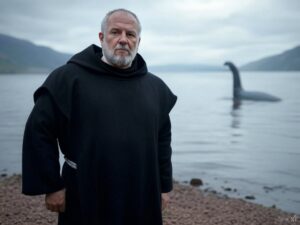
One day, according to legend, as Columba and his followers were nearing the River Ness, they encountered a group of Picts burying a man who had been tragically killed by a water beast. The creature had attacked him as he swam, dragging him underwater, and although rescuers managed to retrieve his body, it was too late.
Unshaken by the tale of this dreadful monster, Columba ordered one of his companions, Lugneus Mocumin, to swim across the river and fetch a boat from the other side. As Lugneus entered the water, the beast, roused by the disturbance, surfaced and charged toward him. The watching crowd, both Picts and Columba’s followers, was struck with terror. But Columba, full of faith, raised his holy hand, made the sign of the cross in the air, and called upon the name of God, commanding the creature, “Go no further! Do not touch the man! Go back at once!”
At the sound of Columba’s voice, the monster, more frightened than if it had been pulled by ropes, immediately retreated into the depths of the river, leaving Lugneus unharmed. The witnesses, awestruck by the miracle they had just witnessed, praised God and marveled at the power of the Christian God. Even the Picts, who had not yet embraced Christianity, were so moved by the event that they gave glory to God.
This event is considered the earliest recorded sighting of what would later become known as the Loch Ness Monster, and it marked the beginning of St. Columba’s legacy as both a miracle worker and a key figure in spreading Christianity among the Pictish tribes.
Legacy
St. Colmcille is remembered as one of Ireland’s greatest saints, and his legacy continues to shape both Celtic Christianity and the monastic tradition. Iona Abbey became a beacon of learning, and Colmcille’s role in spreading Christianity in Ireland, Scotland, and beyond is widely recognized.
He passed away on 9 June 597 AD, and his death marked the end of an era. However, the abbey he founded continued to thrive long after his death, with Colmcille’s influence reverberating across centuries. His legacy endures not only through the monasteries he founded and the cultural impact of Iona Abbey but also through the Latin hymns attributed to him, which are still sung today.
St. Colmcille’s veneration extends beyond the Catholic and Orthodox traditions, cementing his place as a pivotal figure in the early history of Celtic Christianity.