
Monastic Site of Kells

The Kells Monastic Site stands at the heart of Kells, its legacy stretching back over a millennium. The site embodies more than just a place of worship—it was a thriving hub of learning, healing, and debate. Over time, it has shaped both the town and its people, leaving an indelible mark on Ireland’s history. Here’s a deeper dive into the rich tapestry of Kells’ monastic past:
1. Pre-Christian Roots and Early Foundations
Before the monks arrived, Kells was a royal seat, a dún, situated on an important route linking the east coast to the ancient royal site of Rathcroghan in County Roscommon. With connections to legendary figures like Conn Céadchathach (Conn of the Hundred Battles) and Cormac mac Airt, Kells was already a place of significance long before St. Colmcille arrived in the 6th century.
2. The Monastic Boom
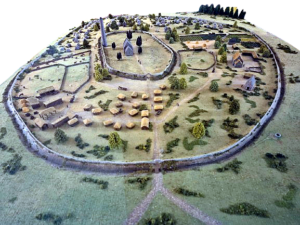
In AD 550, St. Colmcille (St. Columba) established a monastery in Kells, marking the beginning of a long tradition of learning, culture, and spirituality. This site became increasingly important in the 9th century when monks from Iona, fleeing Viking raids, sought refuge here, bringing with them invaluable knowledge, including the Book of Kells—one of the greatest treasures of early Christianity.
Kells wasn’t just a religious center; it was also a school of learning. Kings, queens, and the elite of Ireland sent their sons to be educated by the monks, making Kells a renowned place of higher learning in the early medieval world.
3. Centre of Healing
Kells also earned its reputation as a centre of healing, where medicinal practices were a part of daily monastic life. The monastery supported infirmaries where herbs were grown and used for various treatments, blending spiritual care with practical healing methods. The monastery was well equipped to care for both the monks and the many visitors who came seeking wisdom or refuge.
4. Rhetoric and Debate
One of Kells’ most fascinating features was its status as a centre for rhetoric and debate. People traveled from all corners of the Irish world to engage in intellectual discussions, arguments, and philosophical exchanges. These debates were essential to the cultural life of the site, cementing Kells as a place of intellectual and cultural importance. It was here that ideas flourished and the seeds for Ireland’s medieval intellectual revival were sown.
5. The Monks’ Daily Life: Farming, Beer, and More
Supporting such a thriving monastic site required immense resources, and the monks of Kells were skilled farmers. It’s believed that to sustain a community of 100 monks, 150 acres of farmland were needed just for bread production alone. To top it off, the monks were allowed a gallon of beer each per day, which required an additional 350–450 acres. But don’t get too excited about the beer—this was no pint of Guinness! The monks brewed it only for three days, and its consistency was more akin to a thick soup than anything else. Despite the humble brew, it played an essential role in sustaining the community.
The monastery also had an extensive agricultural system, including beekeeping, which was vital to the monastic economy. Honey was not just for sweet treats—it played a key role in medieval medicine and in the brewing of mead, which was famously linked to the Irish monastic tradition.
6. The River and Fisheries
The location of Kells Monastery, on the banks of the Blackwater River, allowed the monks access to fish ponds, essential for both sustenance and trade. This strategic position near the Boyne River made the monastery an important part of the greater Boyne Valley’s thriving trade network.
7. The Legacy: From a Monastery to a UNESCO Treasure
The Kells Monastic Site has left an undeniable legacy not only in Ireland but across Europe. Monks like St. Colmcille took skills such as farming, mill construction, and manuscript production to Europe during the “Dark Ages”, helping to shape the early medieval period. These skills were exported across the continent, leaving a lasting imprint on European monasticism and governance.
For this reason, Kells and other early Christian monastic sites in Ireland were placed on the 2010 Tentative List for UNESCO World Heritage status. As part of the Lands of Saints and Scholars, Kells stands as a beacon of Ireland’s significant contribution to European culture and learning during the Dark Ages.
8. The Architectural and Cultural Significance
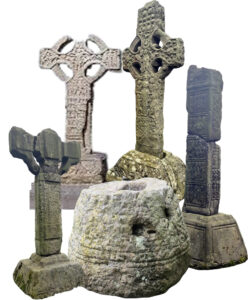
The site itself is a stunning testament to Kells’ monastic legacy, with several notable structures still standing today:
-
Round Tower: This 11th-century tower served as both a bell tower and a place of refuge during attacks. Standing nearly 30 meters tall, it remains an iconic symbol of Kells.
-
High Crosses: The four remaining high crosses on the site are exquisite examples of Celtic craftsmanship. The South Cross is the most intact, featuring stunning biblical carvings, while the West Cross, East Cross, and North Cross offer a glimpse into the artistic heritage of the time.
-
St. Colmcille’s House: A stone oratory dating back to the 9th century, this structure possibly housed the relics of St. Colmcille.
-
Town Walls: The alignment of Kells’ town walls follows the boundary of the original monastic site, underscoring the site’s historical continuity and importance.
9. The Present and Future
Visitors to the Kells Monastic Site today can walk through history, experiencing the evolution of a royal seat to a scholarly hub, and ultimately to the thriving town it is now. The remains of the monastic complex speak of a time when Kells was a beacon of learning, healing, and debate—places where the past is still very much alive.
So, come explore the captivating story of Kells, where history, heritage, and legend intertwine to create an experience unlike any other. Let the echoes of ancient debates and the whispers of monks lead you on a journey through time.
Pick up your visitor’s map at the Kells Courthouse Tourism and Cultural Hub.